


On this page
- 10 dollar deposit casino: what is the decision being compared?
- Currency and residency: which conditions must match across sources?
- Threshold ladder: how do one, five and ten dollar searches differ?
- Complete cost ledger: what happens between ZMW and account credit?
- Method matrix: how do payment routes change the evidence needed?
- Payment timeline: which record belongs to which event?
- Bonus choice: how should an offer change a route comparison?
- Game access: why does ten dollars not define the playing experience?
- Withdrawal planning: what should be understood before entry?
- Agent and mobile enquiries: which relationship does the receipt document?
- Worked cost comparison: how can two ten dollar offers differ?
- Worked account comparison: which unresolved condition changes the answer?
- Final shortlist: when is enough evidence still not a reason to participate?
- Evidence: strengths and limits
- Questions from the search cluster
10 dollar deposit casino: what is the decision being compared?
Define an entry condition, not a recommended budget
The number in this search is a proposed entry amount, not a recommendation to spend it. An adult can complete the comparison without opening an account or making any payment.
For this page, ten dollars is a search condition rather than an established GSB tariff. We have not confirmed the brand's applicable minimum, currency or method for that exact amount.
A meaningful comparison identifies the entire money journey. It begins with discretionary spending money and ends with a clearly defined account or withdrawal state, rather than stopping at an attractive headline.
The amount also needs a unit. Different dollar currencies cannot be treated as identical, and this guide does not convert an unspecified dollar label into a verified minimum in ZMW.
Separate the route comparison from the advertising card
The supplied GSB showcase is visually prominent because that format was requested for this project. It is not a finding that GSB accepts ten dollars or leads a tested payment ranking.
The rating, review total and promotional wording are supplied display inputs. Their presence cannot fill missing fields for eligibility, method availability, conversion costs or the treatment of a remaining balance.
Our research did not create accounts or execute transactions. The examples below are fictional comparison files that show how different evidence gaps change a conclusion without making claims about private accounts.
Generated pictures provide a betting related setting rather than proof of payment support. No illustrated phone screen, receipt or banknote documents a real GSB interface, customer transaction or confirmed entry threshold.
Set the comparison questions before examining offers
Start with currency, residency, contracting identity, method minimum, complete cost and withdrawal conditions. Write those fields down before reading promotional percentages so an appealing offer cannot quietly replace a mandatory question.
Keep the proposed amount fixed during the analysis. If a candidate requires a higher entry, record the mismatch instead of increasing the budget merely to preserve that candidate in a shortlist.
A lower entry condition also deserves its own record. It does not automatically make the complete route cheaper, clearer or appropriate when another stage introduces a cost or an unresolved condition.
No candidate has to qualify. An empty verified shortlist can be the correct result when the available evidence does not support the resident, currency and route needed for this comparison.
The useful output is therefore a decision sheet, not a forced winner. It shows what each source supports and why an unanswered material question prevents a more confident conclusion today.
Currency and residency: which conditions must match across sources?
Keep dollar currencies distinct
An amount in USD and an amount in CAD belong in separate currency fields. A shared dollar symbol is insufficient evidence that two articles describe the same funding threshold or account conditions.
The pages observed in Zambia configured search results include foreign-market material. Their word counts can inform an editorial comparison, but their currency assumptions do not become local operator facts by appearing there.
Use an explicit currency code from the relevant terms, not a symbol inferred from a page's design. If the code remains missing, leave the threshold unresolved instead of choosing a convenient interpretation.
This project uses ZMW for Zambia's currency context. It does not provide an executable exchange quote, a reserved conversion rate or a statement that an operator must use a reference market rate.
Identify which resident the agreement covers
Read residency and product conditions separately from language and website accessibility. An English page that loads in Zambia does not independently establish permission to create the account or use its payment routes.
The comparison also needs the contracting entity named in the applicable agreement. A familiar brand name or a locally styled page does not resolve who operates the account or handles a dispute.
If authorisation is claimed, preserve the claim and seek its appropriate authoritative match. This guide doesn't replace that investigation with a decorative licence badge or an assumption based on another country's article.
We have not completed current operator authorisation verification for GSB. That remains an explicit prelaunch boundary and isn't repaired by an exact deposit phrase, a known payment brand or supplied review figures.
Resolve conflicts without combining incompatible terms
Suppose one source names a currency while another names a method for a different market. Combining their convenient parts would create an imaginary route that neither source actually describes as a whole.
Keep both statements with their dates and contexts. Ask which applicable document governs the intended resident rather than choosing whichever version makes an entry amount look smaller or a promotion more appealing.
A support reply can help identify a relevant document, but it remains a statement by that service. It is not an independent account test or a universal guarantee about future eligibility decisions.
If the conflicting context cannot be reconciled before a financial action, stop the comparison at that boundary. A small or familiar looking amount is not a reason to experiment with unresolved eligibility.
Record the precise missing link: currency, resident, product or contracting entity. This is more useful than a vague safe label because it identifies what evidence would actually change the research conclusion.
Threshold ladder: how do one, five and ten dollar searches differ?
Compare the same route before comparing amounts
An amount comparison is meaningful only when the currency, resident and method stay consistent. Otherwise differences attributed to the threshold may actually come from a different payment route or contractual context.
For a hypothetical route accepting several amounts, compare each against the same complete cost definition. Don't count one option before conversion and another after conversion, because their totals would have incompatible endpoints.
The minimum, the chosen deposit and the bonus qualifying amount should occupy separate fields. They can answer different questions even when an advertisement places them together beside one prominent payment button.
This page's focus is the ten-dollar comparison across routes and balance stages. The separate one-dollar guide concentrates on unit ambiguity, small entry costs and precise threshold interpretation rather than duplicating this article.
Do not rank larger deposits as better value automatically
A fixed charge can form a different share of different amounts, but that arithmetic does not recommend increasing the deposit. A higher amount also changes the personal money exposed to gambling.
Likewise, a larger promotional display does not establish a more useful withdrawal outcome. The applicable balance treatment and conditions remain necessary before deposit money and bonus credit can be understood together.
Compare the absolute outlay as well as a quoted percentage. A lower fee share isn't the same as a lower cost, and neither measure establishes that gambling is affordable for the reader.
If the intended discretionary amount is smaller than a candidate's minimum, the candidate fails that requirement. Changing the personal boundary to make the table look complete would defeat this comparison’s purpose.
Treat missing tiers as missing evidence
A published ten dollar condition doesn't prove a five dollar or one dollar option exists. Each exact threshold claim needs support rather than being interpolated from a larger amount that appears elsewhere.
The reverse inference also fails: an advertised smaller minimum doesn't establish the costs or conditions for every larger payment. Preserve the applicable method rules instead of assuming all amounts receive identical treatment.
Our research keeps the five dollar cluster separate because its comparison sources were incomplete. The missing source isn't assigned zero words or used to create an artificially easy editorial target for publication.
Distinct search phrases don't automatically justify near-identical pages. A separate article needs a genuinely different decision framework, suitable source evidence and useful analysis rather than an amount changed in the heading.
This threshold ladder is therefore an analytical comparison, not an operator price list. None of its amount labels establishes a GSB entry requirement, a successful payment or promotional eligibility.
| Search condition | Comparison focus | Not established by the amount |
|---|---|---|
| One dollar | Exact unit, entry definition and fixed cost sensitivity | An available GSB one-dollar route |
| Five dollars | Separate threshold evidence and its applicable method | Interpolation from another amount |
| Ten dollars | Cross-method costs and account balance stages | A recommendation to increase spending |
| Any amount | Resident, contracting identity and exit conditions | Legal clearance or a guaranteed result |
Complete cost ledger: what happens between ZMW and account credit?
Define the opening and closing balances
Our ledger begins with a discretionary amount in a named currency and ends with a named credited balance. Both endpoints must be explicit before costs from different routes can be compared sensibly.
An amount held in a wallet, an amount shown in a casino ledger and money available for everyday spending are different comparison states. Don't treat their identical looking numbers as equivalent evidence.
For a hypothetical ten dollar account credit, the local outlay depends on the applicable conversion and charges. This guide supplies no current rate or operator tariff to fill those inputs for GSB.
If a quote describes only the sending side, label it accordingly. It cannot independently establish the amount ultimately credited after another service applies its own stated conversion or receiving side conditions.
Reconcile charges without double counting
Create a row for every relevant stage: acquisition or initial conversion, transfer, receiving conversion and any stated operator charge. Keep the quoting party and included costs beside each row to preserve interpretability.
A quoted spread may already be reflected in a conversion amount. Record that inclusion instead of subtracting the same effect again, which would overstate the route's cost and distort a comparison.
Unknown charges stay unknown in this method. Treating an empty field as zero would make an incomplete route appear cheaper without obtaining the evidence needed to support that conclusion for the reader.
Use consistent endpoints when another route skips a stage. A direct account credit and a wallet balance waiting for conversion shouldn't be compared as though they were the same final usable balance.
Use a symbolic worksheet instead of invented prices
Let A be the starting amount, F the explicit charges and C a separately defined conversion effect. Under these simplified assumptions, the resulting value before gambling is A minus F minus C.
The formula is only a reading aid. It does not identify an available payment route, predict a game result or demonstrate that a particular operator applies those components in that exact form.
If a quote already incorporates a component, keep it inside the relevant value rather than deducting it twice. State the assumption clearly so another reader can reproduce the reasoning without guessing.
Where values use different currencies, do not subtract them directly. First obtain a consistent quoted basis or leave the calculation unresolved, instead of producing a precise looking total from incompatible units.
This worksheet can reject an unclear route before money moves. That is a useful result: financial exposure is not necessary merely to establish that the available price information is incomplete or contradictory.
| Row | Record | Reconciliation question |
|---|---|---|
| Opening amount | Currency and discretionary outlay | Is this the same starting point for both routes? |
| Quote | Named provider, time and included charges | Is the charge already included? |
| Transfer | Sent value and relevant record | What event does this receipt describe? |
| Account credit | Currency, amount and balance type | Was there another conversion or condition? |
| Intended exit | Destination, currency and applicable policy | Is this the same final usable state? |
Method matrix: how do payment routes change the evidence needed?
Give each method its own column
The comparison matrix uses a separate column for each proposed payment route. A condition verified for one method shouldn't automatically fill the corresponding field for another method sharing the same account interface.
For every column, record currency, entry definition, ownership conditions, source date and exit documentation. A payment logo alone answers none of those fields, even if it makes the route easy to recognise.
The public regional help names used elsewhere on this site provide starting points for method research. They don't confirm a ten dollar equivalent or universal availability for every GSB account and operation.
If a method isn't documented for the relevant situation, keep that column unqualified. Don't replace the missing evidence with assumptions about what the wallet or card provider can do for other merchants.
Separate provider capability from merchant acceptance
A wallet service may support an operation without a merchant enabling it. The comparison therefore asks for the operator's applicable method instructions in addition to any general provider explanation of its service.
Likewise, cryptocurrency technical support needs an asset and network context, not just a familiar symbol. This project has not established a GSB crypto cashier and doesn't infer one from the threshold search.
For a cash or agent enquiry, identify the documented merchant relationship and account credit record. An ordinary cash exchange isn't enough evidence that a recognised operator account has received the intended amount.
For a card enquiry, keep issuer or provider conditions separate from merchant account conditions. A charge displayed by one system wouldn't, by itself, explain every receiving side check or a later withdrawal.
Compare complete routes rather than isolated advantages
A convenient entry feature doesn't establish the exit route. Check whether the method's withdrawal availability and conditions are documented instead of assuming that deposit acceptance proves unrestricted access to the remaining balance.
A fast sending notification also does not establish end-to-end speed. The comparison needs consistent event boundaries before it can interpret what a timing statement measures or compare that statement with another route.
If a cost advantage concerns only one stage, describe it narrowly. Don't turn a stated absence of one charge into a fee-free journey or a general ranking of the operator's payment performance.
An unresolved column doesn't have to be completed by trying the payment. Reading conditions and asking a precise question can be enough to decide that the proposed route remains unsuitable for comparison.
The matrix should finish with evidence statuses, not invented stars. It explains which route is understandable under the stated conditions without claiming that the publisher tested an account or guarantees an outcome.
| Proposed route | Needed operator evidence | Separate provider question |
|---|---|---|
| Mobile money | Applicable merchant instructions and account credit process | What does the provider record actually describe? |
| Cash or agent | Documented recipient relationship and receipt-to-ledger link | Who receives money and issues the record? |
| Card | Applicable country, currency and method conditions | Which issuer or provider conditions apply? |
| Cryptocurrency | Explicit asset and network route plus eligibility | What can the sending wallet support? |
| GSB ten-dollar condition | Not verified by this publisher | No method logo fills the missing threshold field |
Payment timeline: which record belongs to which event?
Build an event ledger
Use a separate row for the proposed instruction, the sending event, any provider status and the operator's account entry. These categories help organise evidence without assuming every service uses identical processes.
Attach each reference to the system that issued it. A wallet record shouldn't silently become an operator approval record because the number or time appears similar in another part of the comparison.
The ledger should preserve event order and the currency labels visible in each source. A matching looking amount isn't enough to establish that two entries describe the same transaction or balance movement.
If one event is missing, mark the gap rather than filling it with the expected next step. A coherent-looking timeline built from assumptions is weaker evidence than an incomplete documented history.
Distinguish pending from a second instruction
A pending label is a reason to inspect the existing record, not an instruction to repeat a payment. Another similar transfer can increase exposure and make the history more difficult to reconcile.
Ask which system reports the status and what object it describes. A provider's pending event and an operator's pending request may concern different stages, so matching words don’t establish matching causes.
Preserve relevant status changes instead of replacing earlier screenshots with the latest screen only. The sequence may explain which party last recorded an event and which stage needs the responsible service’s clarification.
This guide cannot determine a private account outcome from an isolated status. It offers an evidence structure rather than a diagnosis, a refund promise or instructions to send money to resolve uncertainty.
Prepare a focused enquiry
State the last supported event, the next unresolved event and the nonsecret references. This makes the question more precise than saying the whole payment system failed when only one stage is unclear.
Keep unrelated balances, contacts and identity material out of a public enquiry. A small deposit question doesn't justify publishing financial history or sharing secrets that could expose another account or wallet.
Use the responsible service’s verified channel. A private message from an unknown intermediary isn't evidence that the sender controls the receiving account or can resolve the issue.
If two services provide conflicting explanations, preserve both statements and their dates. The comparison remains unresolved until suitable evidence reconciles them; it shouldn't choose the version that favours a promotion.
No test transfer was performed for this article. The ledger is an analytical worksheet and mustn't be interpreted as a record of a ten-dollar payment completed through GSB or another named operator.
Bonus choice: how should an offer change a route comparison?
Check eligibility without combining unrelated claims
A ten-dollar funding route and a welcome offer need their own evidence before they can be described together. A source supporting the entry amount doesn't establish the campaign's qualifying threshold or eligibility.
For GSB, the supplied headline remains unverified promotional input. It doesn't confirm that ten dollars activates an offer, that a specific method qualifies or that the campaign applies to a Zambian account.
Read the same applicable campaign version for every offer field. Mixing a general help page with an expired promotion can create a package that no source currently offers to that reader.
If the necessary relationship is absent, keep the funding and offer rows separate. Don't estimate a smaller benefit or borrow a familiar rule from another operator simply to complete the comparison table.
Compare acceptance and nonacceptance as separate questions
The comparison should ask what the terms say about accepting, declining or cancelling an offer. It shouldn't assume the effect on personal deposit money, promotional credit or related outcomes without the conditions.
A clearly explained option can make the contract easier to understand without making gambling beneficial. The decision to decline participation remains separate from whether promotional conditions are readable or consistent.
If wagering is required, identify its base and eligible activity’s contribution. A match percentage alone cannot establish the turnover, expiry consequences or treatment of a request to withdraw a remaining balance.
This article doesn't recommend pursuing turnover to unlock a promotion. Understanding a contractual requirement is not evidence that completing it is affordable, necessary or appropriate for the person considering the account relationship.
Model the obligations without inventing a brand tariff
In a hypothetical offer, a stated base B and a multiple W would define turnover B times W. The base must come from the example's conditions, not from a guessed operator rule.
If a hypothetical game credits only a fraction of activity, the nominal stakes and credited progress differ. That relationship explains why an apparently simple bonus headline needs explanation beyond a percentage.
The model doesn't predict winnings or the amount eventually available for withdrawal. It also doesn't supply GSB's base, multiple, contribution rates or campaign duration, which this project hasn't verified for this threshold.
If a condition is missing, leave the model incomplete and identify the missing input. A precise-looking calculation from invented assumptions would be a weaker comparison than a candid evidence boundary.
The final offer assessment should therefore name conditions and unknowns, not assign an unsupported cash value. The supplied advertising card remains separate and cannot override its unresolved fields.
Game access: why does ten dollars not define the playing experience?
Keep funding and stakes separate
An account funding threshold doesn't specify a game's minimum stake or available versions. Those details need the applicable rules and catalogue context rather than an inference from an accepted payment amount.
The comparison should identify the exact game question before collecting evidence. A request about a slot's stake is different from a request about a cashier minimum, despite both mentioning an amount.
This publisher hasn't verified a GSB game count or a stake schedule for a ten-dollar balance. Generated slot screens illustrate gambling objects without documenting an actual title, catalogue entry or tested session.
If a game is unavailable for the country or product, a deposit condition doesn't make it available. Keep the game and account eligibility fields separate without letting payment evidence fill both.
Avoid predicting how long a balance will last
A simplified balance divided by a hypothetical stake can describe a sequence without returns. It doesn't predict session duration, the game's outcomes or the amount remaining after an actual period of participation.
Don't turn that illustration into a recommendation to maximise rounds. Readers need not spend everything, accept a promotion or increase stakes because a calculation suggests further activity is possible.
The time spent and money exposed are separate boundaries. A low entry threshold doesn't establish either one, and a convenient interface shouldn't decide how long an information search or gambling session continues.
A bonus balance also needs its own treatment before inclusion in illustrative calculations. Promotional credit cannot be counted as unrestricted personal money without checking the applicable conditions governing its use and withdrawal.
Read game claims within their own scope
If a product describes outcome verification or testing, inspect the explanation and its limits. A payment asset, a general platform badge or a screenshot doesn't independently establish every game’s fairness.
The comparison keeps game information separate from operator identity and payment handling. Evidence supporting one subject cannot automatically certify another subject, despite appearing on one branded page or screen.
This article provides no winning signals, guaranteed multipliers or method for recovering a lost balance. The earlier funding amount doesn't establish grounds for expecting an outcome or pursuing another wager.
For a title-specific question, consult the game's applicable rules and this site's relevant game guide. Preserve the difference between describing a rule and claiming independent performance or outcome testing.
The useful game comparison concerns understandable information and evidence gaps. It shouldn't transform an exact ten-dollar search into a promise of longer entertainment, a reliable return or a financial solution.
Withdrawal planning: what should be understood before entry?
Define the desired exit state
An exit comparison needs a destination, currency and stage definition. A request submitted, an approval message, a transfer record and spendable funds received are different events not interchangeable withdrawal completion descriptions.
The entry route doesn't establish that the same method is available for withdrawal. Keep its separate exit documentation visible instead of assuming that a recognised payment logo answers both payment directions.
This publisher hasn't tested a ten dollar GSB withdrawal or established a payout deadline. A foreign comparison article's estimate doesn't become an operator commitment for a Zambian resident or a private account.
The question is whether the applicable conditions are readable and internally consistent. Clear documentation explains the process, but it isn't a guarantee that a request will be approved or completed.
Examine remaining balances and account closure
If a remaining balance falls below a published withdrawal threshold, read the applicable policy or seek clarification. Don't assume that adding funds or gambling the remainder is the only response.
Keep personal deposit money, promotional credit and closure treatment in separate evidence fields. They may be governed by different conditions, and combining them into a single instruction could conceal the unresolved question.
The comparison should also identify which service holds the account record. An affiliate page cannot approve a request, return money or replace the operator's documented account process with an illustrative promise.
If support provides a different explanation from the terms, preserve both versions and request reconciliation. An unresolved disagreement remains relevant despite apparent convenience elsewhere or the deposit looked modest.
Assess timing without a payout promise
A speed statement must define the event it measures and retain its qualifications. Compare statements with matching endpoints rather than ranking operator approval against another route's complete receipt journey as equivalents.
Personal anecdotes need their account and method context. They can describe an experience if properly attributed, but this guide doesn't average incompatible reports into a universal processing deadline or tested reliability.
If a withdrawal question remains unresolved, it can disqualify the route from comparison. A advertised entry amount doesn't compensate for a missing exit policy or an unexplained restriction on the balance.
Beware of unsolicited offers to unlock a balance after an additional payment to another address. Independently verify the service relationship instead of treating a further-payment demand as proof of genuine recovery.
The correct comparison outcome may remain unknown after reading all accessible material. This guide doesn't diagnose a private dispute or promise reversal, compensation, recovery or a specific outcome from an operator enquiry.
Agent and mobile enquiries: which relationship does the receipt document?
Identify the payment recipient
Cash counters and mobile money screens need documented merchant relationships. The presence of a betting related object doesn't establish that a person collecting money is authorised to fund that account.
For a hypothetical agent route, the comparison asks who receives the payment, who issues the receipt and where operator credit would appear. These are separate questions, not assumptions based on location.
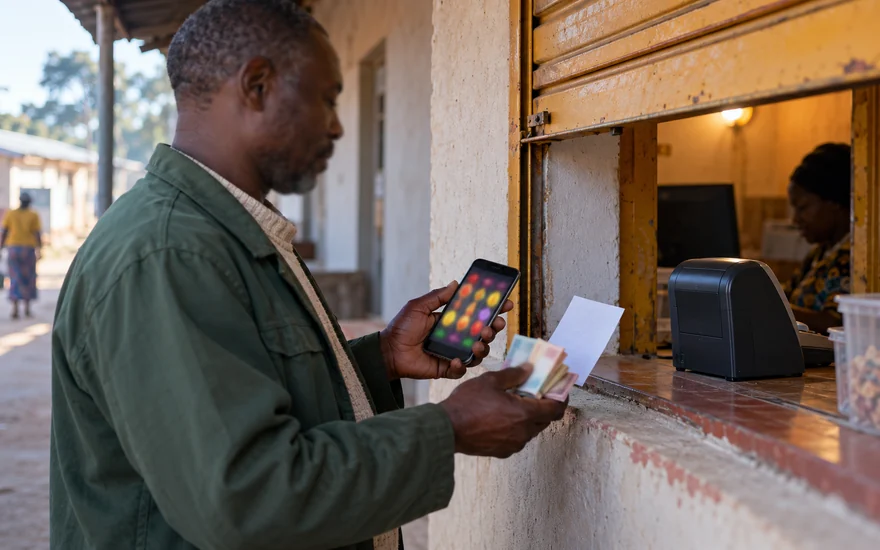
Our images are generated editorial scenes, not visits to a GSB shop or payment agent. They cannot verify a merchant relationship, a ten-dollar equivalent or the operator’s actual account process.
Keep merchant instructions separate from ordinary transfers
An ordinary transfer between people isn't automatically the same operation as a documented merchant payment. The comparison should identify the operation from applicable instructions before interpreting a receipt or a proposed threshold.
If an intermediary gives instructions that differ from published operator instructions, record discrepancies and verify relationships. Don't assume the difference is harmless because a confident person or affordable amount is involved.
This guide doesn't provide a merchant code, payment address or instruction to move funds. Its purpose is to identify the missing evidence, not to improvise an unclear operator route.
For an account question, use the operator's verified channel and relevant records. An affiliate page cannot authenticate an agent, confirm a private account credit or guarantee another service’s cash or mobile outcome.
Protect the record without publishing secrets
Keep the currency, amount label, time and relevant receipt reference in private records. Those fields can help distinguish a cash payment from an account entry without publicly exposing unrelated personal information.
Don't send identity documents, wallet recovery material or authentication codes to this publisher. It has no payment verification function and doesn't need confidential access to explain how a comparison worksheet is structured.
If someone asks for a second payment to confirm the first, stop and independently verify the request. Additional money movement would be another financial action, not proof of the event’s intended completion.
Where the relationship or receipt cannot be reconciled, the proposed route remains unqualified. That's a limit of the available evidence, not a finding that every agent or mobile method is universally unreliable.
Worked cost comparison: how can two ten dollar offers differ?
Case A: different endpoints behind matching numbers
Imagine two hypothetical pages both showing a ten-dollar label. Candidate A describes account credit, while candidate B describes a wallet amount before another conversion. The numbers match, but their defined endpoints don't.
Our worksheet records the difference rather than awarding a tie. The missing information is the remaining stage’s value and conditions, needed before a consistent route comparison.
No actual operator is represented by either candidate. The example demonstrates why an entry amount should be attached to a named event instead of being treated as complete cost or access information.
Case B: a quote already includes a charge
Suppose a hypothetical provider quotes an all-in local outlay and separately displays the charge included within it. Adding that charge again would overstate cost, even though the copied numbers appear sourced.
The correct worksheet preserves the quote's scope and reconciles its components once. If the inclusion is unclear, the uncertainty remains visible instead of being resolved through assumptions favouring either candidate.
This example is arithmetic and source interpretation, not a fee schedule. It doesn't assert that GSB or a payment provider uses an all-in quote, applies a charge or supports this ten-dollar route.
The lesson also applies when a cost is excluded. A headline amount shouldn't be called complete until the source explains which stages and charges it covers and which parts remain excluded.
Case C: a percentage looks better while outlay rises
Consider a hypothetical fixed charge spread across two entry amounts. Its share can fall as the amount rises, while absolute commitments increase. A lower percentage therefore doesn't establish a lower personal outlay.
The comparison should show both measures and retain the spending boundary. It shouldn't suggest depositing more to improve a ratio, because that changes the financial decision rather than clarifying the route’s evidence.
An adult may reject both options even if their costs are documented. Accurate arithmetic doesn't establish that gambling is necessary, affordable or suitable, and it doesn't remove possible loss of committed money.
This is why the decision sheet keeps personal relevance separate from source completeness. A route can be understandable yet unsuitable, while appealing entry numbers remain unassessable without material information.
Worked account comparison: which unresolved condition changes the answer?
Case D: the bonus has another base
Imagine a source that describes a funding amount but doesn't identify the promotional wagering base. The route's entry field can be documented while the offer calculation remains incomplete; these findings remain separate.
The missing input should be named rather than guessed. Selecting the smaller possible base would make the promotion appear clearer, but it wouldn't establish that the calculation represents applicable offer conditions.
If the definition later becomes available, check its campaign version and eligibility context. A new document can change one evidence field without proving an independent account test or settling other promotional questions.
Case E: the deposit record and ledger disagree
In a fictional timeline, a sending receipt exists but no matching operator credit is documented. The worksheet identifies the last supported stage leaving account credit unresolved without assuming the receipt proves both.
The next enquiry concerns that gap and the service controlling it. A second payment, a different method or a larger amount wouldn't explain the first record and could complicate reconciliation.
This publisher cannot adjudicate the fictional account or promise a recovery. The example supplies a precise question without turning an uncertain record into an allegation about a named operator or customer.
If an explanation arrives, preserve its source and date alongside the records. A support statement may clarify the process, but its scope shouldn't be expanded into a universal account or withdrawal guarantee.
Case F: a remaining balance has an unclear exit
Suppose a fictional account balance remains after participation, while the accessible source doesn't explain its applicable withdrawal or closure treatment. The entry minimum cannot answer that new question, despite documented entry.
Our comparison keeps withdrawal, promotional balance and closure conditions separate. It doesn't recommend gambling the remainder or adding funds to reach a guessed threshold, because those are financial decisions, not evidence checks.
What could change the result is a relevant policy or reconciled account explanation from the responsible service. An unrelated instant payout advertisement wouldn't provide the same answer about that remaining balance.
The conclusion may remain don't proceed with the proposed route. An exact amount in a search phrase doesn’t oblige participation, financial experimentation or continued gambling to simplify apparent account closure.
| Case | Supported finding | Unresolved or separate condition |
|---|---|---|
| Matching ten-dollar labels | Each source names an amount | Endpoints or currencies may differ |
| All-in quote | Source states included cost | Do not count that component twice |
| Falling charge percentage | Ratio changes with the amount | Absolute spending and gambling exposure also matter |
| Offer base missing | Entry condition may be readable | Bonus obligations are not calculable yet |
| Receipt without ledger entry | Sending event is documented | Receiving account credit remains unresolved |
| Remaining balance | An account amount is recorded | Withdrawal and closure treatment need their own policy |
Final shortlist: when is enough evidence still not a reason to participate?
Review mandatory conditions without changing the budget
Return to the initial currency, residency, identity, method, cost and exit questions. Evaluate the initial definitions rather than adopting a more convenient standard after encountering an attractive promotion or familiar payment logo.
For GSB here, the exact ten-dollar minimum and matching promotional conditions remain unverified. The supplied display figures cannot place the brand in a confirmed ten-dollar shortlist or fill the missing payment field.
A candidate requiring a different amount remains a mismatch for this exact comparison. Don't change the personal spending boundary to make a table longer, accept a campaign or avoid an empty shortlist.
Keep gambling separate from financial needs
Essential spending and borrowed money don't become discretionary because an entry threshold looks modest. A low minimum or familiar payment route isn't a financial solution, recovery method or dependable income.
GamCare's general money guidance highlights gambling-related financial harm and the importance of spending control. Its geographically scoped services aren't presented here as Zambian operator support or a guaranteed local support channel.
If maintaining a boundary is difficult, step away from gambling rather than comparing another promotion. This site's stopping and closure material provides a separate information path without accepting the supplied offer.
Track aggregate commitments if considering repeated amounts, not only the latest small payment. Several individually modest entries and their costs can represent a materially different exposure from the original deposit question.
Preserve the evidence boundary in the final result
This is a dated editorial comparison, not a live cashier, tested operator ranking or reserved offer. Its inactive affiliate placeholder cannot create an account, validate a threshold or confirm eligibility through clicking.
A future update should identify the new source and the field it changes. It shouldn't imply that an account or transaction test occurred after merely reading new documentation or reconciling sources.
Where the evidence remains incomplete, say what is missing and stop there. A complete-looking page or a word count isn't justification to invent brand minimums, payout times, bonus rules or legal assurances.
The final choice can be no payment and no participation. The comparison still serves readers who understand the currency, route and unresolved conditions without being pushed into a financial action.
What the evidence helps with
- Identifying the specific $10 route comparison question.
- Separating published guidance from an account-specific outcome.
- Following the relevant records and verified source chain.
What remains unverified
- No account, payment, support or application performance test.
- Supplied score, reviews and promotional wording are not independent results.
- Current operator authorisation and final publisher details require confirmation.
Questions from the search cluster
What does a 10 dollar deposit casino threshold establish?
It can describe an entry condition only when the currency, method and applicable account context are specified. It does not establish minimum stakes, bonus qualification, withdrawal availability or a tested payment result.
Does GSB accept a ten dollar casino deposit?
This project has not confirmed an exact ten dollar GSB minimum or matching payment route. The supplied advertising inputs are separate from applicable method conditions and cannot validate that amount.
Is a 10 dollar minimum deposit always USD?
The currency needs an explicit code from the relevant source. A dollar symbol alone can be ambiguous, and this guide does not turn a foreign headline into a verified ZMW minimum.
How should a 10 dollar deposit online casino be compared?
Use consistent start and end points across routes, with currency, residency, costs, method conditions and exit evidence. Unknown fields remain unresolved rather than becoming zero charges or invented acceptance claims.
Does a ten dollar deposit activate a casino bonus?
Funding and promotional qualification need separate supporting conditions. This guide does not confirm a current GSB campaign linked to ten dollars or combine an entry amount with an unrelated bonus headline.
Can a ten dollar entry be compared with one dollar?
Only compare amounts using compatible currency, method and account context. A higher amount can change personal exposure even when a fixed charge forms a smaller percentage of the proposed deposit.
Does deposit acceptance prove the same withdrawal method?
Entry and exit availability are separate questions. Check the applicable withdrawal rules, destination and balance treatment rather than inferring them from a payment logo or a documented deposit threshold alone.
Can cryptocurrency confirm a ten dollar GSB route?
Cryptocurrency support requires its own operator asset, network and account evidence. No GSB crypto cashier is verified here, so the ten dollar search cannot establish compatibility or a matching minimum.
Should an unresolved payment be repeated to test it?
First reconcile the existing nonsecret records and identify the unresolved stage through a verified channel. Another payment increases exposure and does not explain what happened to the original event or account entry.
Does a small minimum make repeated deposits affordable?
Track the aggregate commitment and relevant costs instead of judging each entry separately. A modest individual amount does not establish an affordable total or justify using essential money or pursuing losses.
Sources and research boundaries
- help.gsb.co.zm — Regional help source relationship and method naming, not a verified ten-dollar threshold or cashier test.
- www.boz.zm — Zambia currency context only; no live exchange quote is supplied.
- www.gamcare.org.uk — General gambling-related money guidance; service eligibility is geographically scoped and is not Zambia operator support.
Research snapshot: . Source publication dates and availability differ. Competitor targets remain provisional where the strongest comparison set could not be measured.
18+ · Supplied offer conditions and checks
Supplied showcase: score, review total and offer are unverified display inputs, not independently collected reviews or confirmed current GSB terms. This independent guide does not operate betting accounts. Read the current operator conditions before considering participation. This preview has no active affiliate destination, no account form and no payment function.
Prelaunch materials assembled .